Shrinkage Cracks in Concrete: Causes and How Fiber Prevents Them
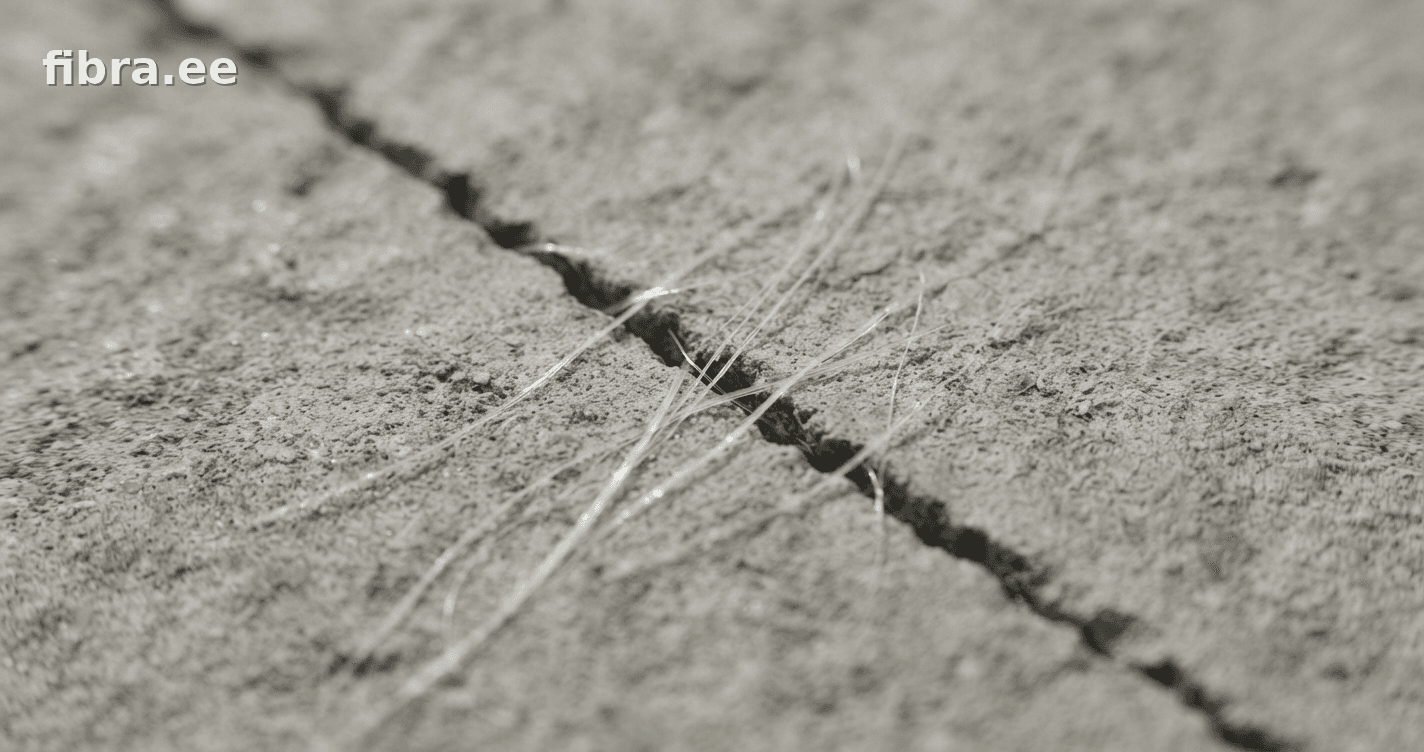
Shrinkage cracks form in concrete because concrete loses volume as it cures — evaporating and binding the water used in mixing — and that shrinkage is almost always restrained: by an adjoining structure, by reinforcement, by friction against the substrate. Restrained shrinkage creates tensile stress, and concrete is weak in tension: once the stress exceeds its tensile strength, a crack forms. This isn't a defect in the concrete — it's a predictable consequence of how concrete cures, and predictable means the risk can be managed in advance rather than dealt with after the fact.
The problem isn't only cosmetic. A crack is a path for water, chlorides, and carbon dioxide to reach the reinforcement — accelerated carbonation, steel corrosion, reduced service life. On a slab on grade, a crack becomes a point of spalling and unevenness over time. On facades and exterior elements, it becomes a point of freeze-thaw damage and further opening through winter cycles.
Plastic shrinkage vs. drying shrinkage — two different mechanisms
Shrinkage cracks fall into two types depending on when they occur, and the distinction isn't academic — it determines which measure actually helps.
Plastic shrinkage happens in the first hours after placement, while the concrete hasn't yet gained strength. Water evaporates from the surface faster than capillary action can replace it from deeper in the mix — the surface layer contracts while the layers beneath are still plastic and offer no resistance. The result is characteristic surface cracking, often within the first 1–6 hours, worsened by wind, direct sun, low humidity, and a high mix temperature.
Drying shrinkage plays out over weeks and months, as the excess mixing water leaves concrete that has already hardened. If that shrinkage is restrained, cracks appear later — sometimes weeks after placement, once the concrete already looks fully set.
Fiber reinforcement is effective primarily against plastic shrinkage and against the crack width from shrinkage in general — but it doesn't eliminate shrinkage as a physical process, and it doesn't replace structural measures: control joints, proper curing, and a correct water-cement ratio.
What causes shrinkage cracks in concrete
Several factors combine to determine crack risk:
- High water-cement ratio (W/C) — more free water in the mix means a larger volume of shrinkage as that water evaporates and binds.
- Rapid moisture loss from the exposed surface — wind, direct sun, low humidity, high mix temperature in hot weather.
- Insufficient curing in the first days — no plastic sheeting, no water curing, no curing compound accelerates plastic shrinkage exactly when the concrete is most vulnerable.
- Restrained shrinkage — a slab poured tight against existing structures, or a base with high friction against the subgrade, can't contract freely, and that stress is released as a crack at the weakest point.
Fiber doesn't remove any of these causes directly. What it changes is how the concrete responds once stress exceeds its tensile strength.
How fiber works against shrinkage cracks
A conventional welded wire mesh reinforces concrete in a single plane — wherever it was physically placed (ideally the middle third of the slab thickness, though in practice that isn't always the case). Polypropylene fiber is distributed evenly through the entire volume of the concrete, in three dimensions, at every point in the mix — including the near-surface layer where plastic shrinkage cracking actually originates.
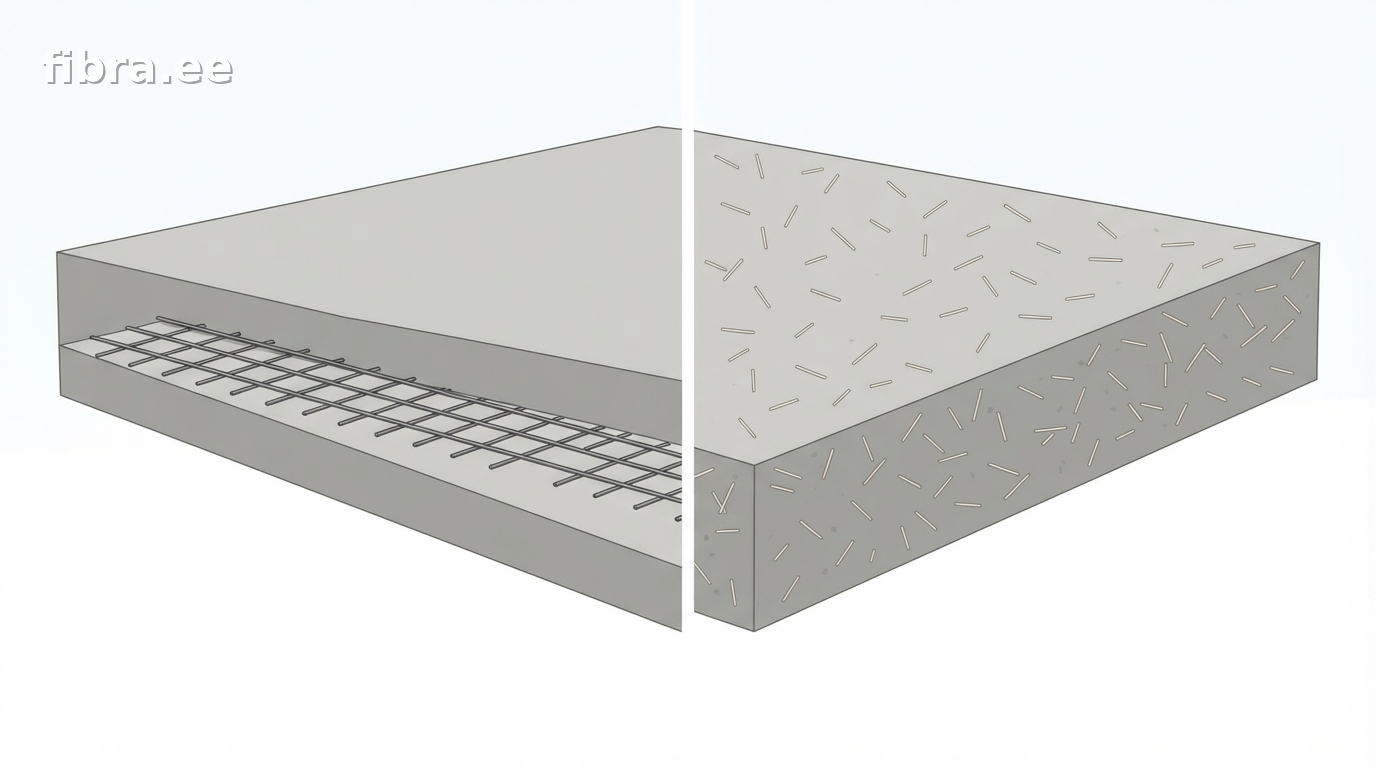
The practical effect: where unreinforced or mesh-reinforced concrete produces one or two wide cracks, fiber-reinforced concrete under the same stress produces significantly more microcracks with substantially smaller crack widths — fiber acts as a bridge across a microcrack the moment it forms, before it can widen and propagate. For water and aggressive substances trying to penetrate, a fine network of microcracks is fundamentally less dangerous than a single through-crack of the same total area. This mechanism — crack-width control through distributed fiber reinforcement — is described in detail in ACI 224R, "Control of Cracking in Concrete Structures", one of the foundational references on crack control in concrete.
A separate effect, unrelated to shrinkage itself: polymer fiber reduces segregation and early bleeding of the mix, which on its own reduces the driving force behind plastic shrinkage in the first hours.
Choosing the right fiber dosage
Dosage depends on the application — it isn't a single universal number, because an underdosed mix doesn't deliver the intended effect, and an overdosed mix doesn't improve the result proportionally to the extra cost.
For plaster mixes and thin screeds, where the risk is mostly plastic shrinkage over a large exposed area, the lower end of the range is usually enough. For thicker floor screeds and foundation slabs, where drying shrinkage over several weeks adds to the plastic-shrinkage risk, the dosage is increased. Exact figures for each type of work are in the fiber calculator: it accounts for volume and work type and converts straight into a specific pack size.
If the question is mesh vs. fiber for a specific slab — that's a separate topic with its own tradeoffs (placement depth, labor, cover thickness) — we'll cover it in detail in the next article.
Where fiber alone isn't enough
Polymer fiber is crack-control reinforcement, not a replacement for structural rebar. For structural elements where the design load requires steel reinforcement — load-bearing slabs, elements with a calculated bending moment — fiber works as an addition that reduces the risk of shrinkage and plastic cracking, not as a substitute for engineered reinforcement.
Fiber also doesn't compensate for gross violations of technique — excessive W/C, pouring in hot windy weather without covering, no curing in the first 24 hours. It reduces the consequences of unavoidable shrinkage, but it doesn't remove the need to follow basic concreting practice.
Frequently asked questions
How soon after placement can a shrinkage crack appear? A plastic shrinkage crack can appear within the first 1–6 hours after placement, while the concrete hasn't yet gained strength. Drying shrinkage cracks show up later — from a few days to a few weeks, as excess moisture leaves the already-hardened concrete.
Can fiber fully replace mesh? For controlling shrinkage cracking — in many cases, yes, since fiber is distributed through the whole volume rather than a single plane. For structural (load-bearing) reinforcement of structural elements, fiber does not replace mesh — that requires a separate engineering calculation.
How much fiber do I need per m³ of concrete? It depends on the type of work — dosage for plaster versus a foundation slab differs several times over. Get an exact figure for your specific job in the fiber calculator.
Bottom line
Shrinkage cracks in concrete aren't random — they're a predictable consequence of curing physics that can be controlled. The right dosage of polypropylene fiber, matched to the type of work, is one of the most cost-effective control tools precisely because it's distributed through the entire volume of concrete rather than a single plane, and it's already working in the first hours, when the concrete is most vulnerable.
Work out the right dosage for your job in the calculator, browse the full product range on the products page, and check the FAQ for other practical questions.