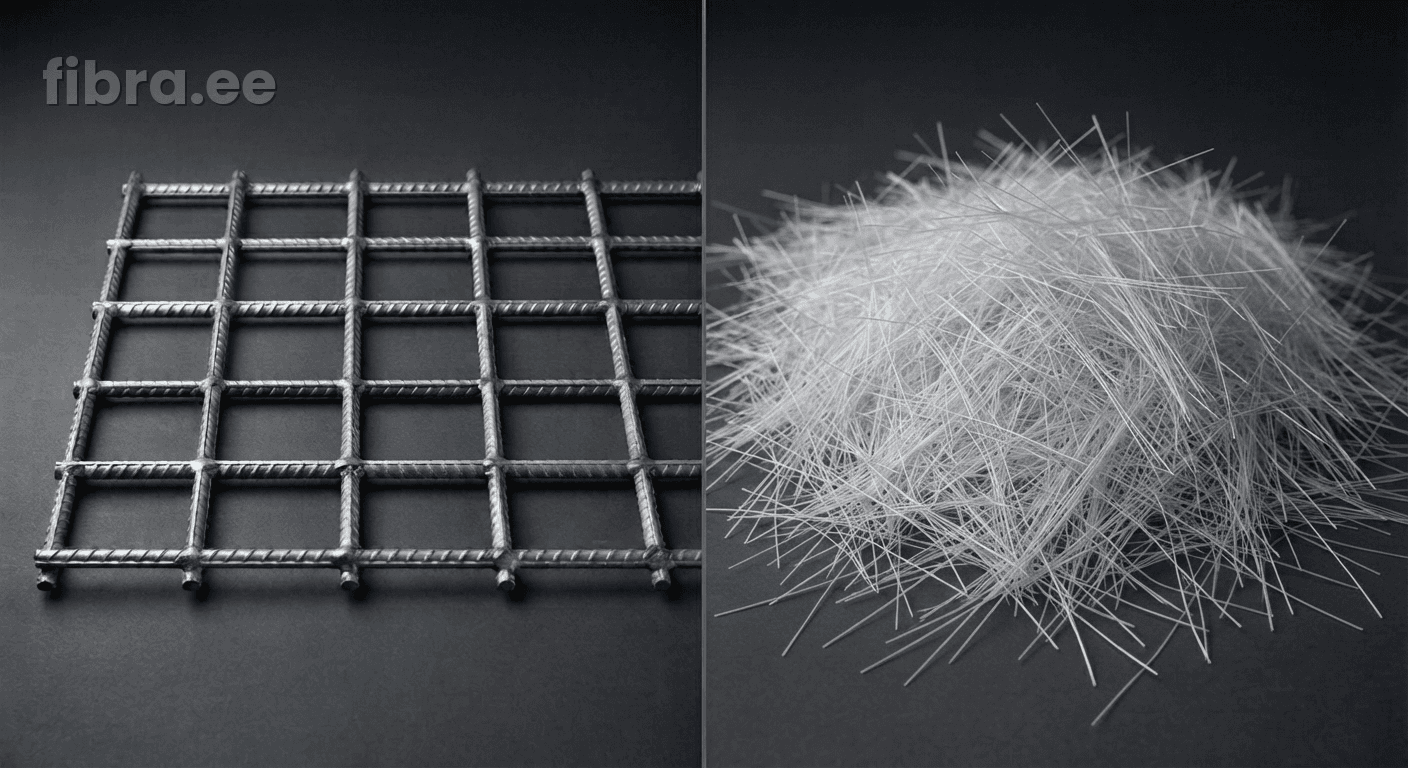
Mesh or Fiber for Floor Screed: How to Choose Reinforcement
When pouring a floor screed, the same question comes up almost every time: lay welded reinforcing mesh, add fiber to the mix — or use both. There's no single "correct" answer, because mesh and fiber solve different problems rather than compete for the same role.
How mesh works
Welded mesh is primary (structural) reinforcement in the terminology used by fiber-reinforced-concrete engineering guides (e.g. FIP-9, Fiber Reinforced Concrete Association): a concentrated element placed at a specific plane within the screed that redistributes stress and works in bending once a crack has formed. For mesh to actually perform this function, two conditions matter:
— it has to sit at the correct height within the screed body (usually the upper third of the layer), not settle to the bottom during the pour — in practice this is one of the most common reasons mesh in a screed turns out useless: without spacers it sinks down and, once cured, simply rests on the insulation or subfloor, doing nothing; — the screed thickness and concrete cover over the mesh have to match its cross-section — otherwise the mesh becomes a source of corrosion and local defects rather than crack protection.
How fiber works
Polypropylene fiber is secondary reinforcement: it's evenly distributed throughout the entire volume of the mix rather than concentrated in one plane. Its job is to restrain plastic shrinkage and microcracking in the first hours and days of curing, while the mix hasn't yet gained strength. The industry's FIP-8 (Fiber Reinforced Concrete Association) states this directly: fibers only come into play once a crack has formed, redistributing tensile stress across it — "fibers do not change the behavior of uncracked concrete." In other words, fiber doesn't prevent a crack from occurring as a physical event — it keeps the crack from opening up and growing.
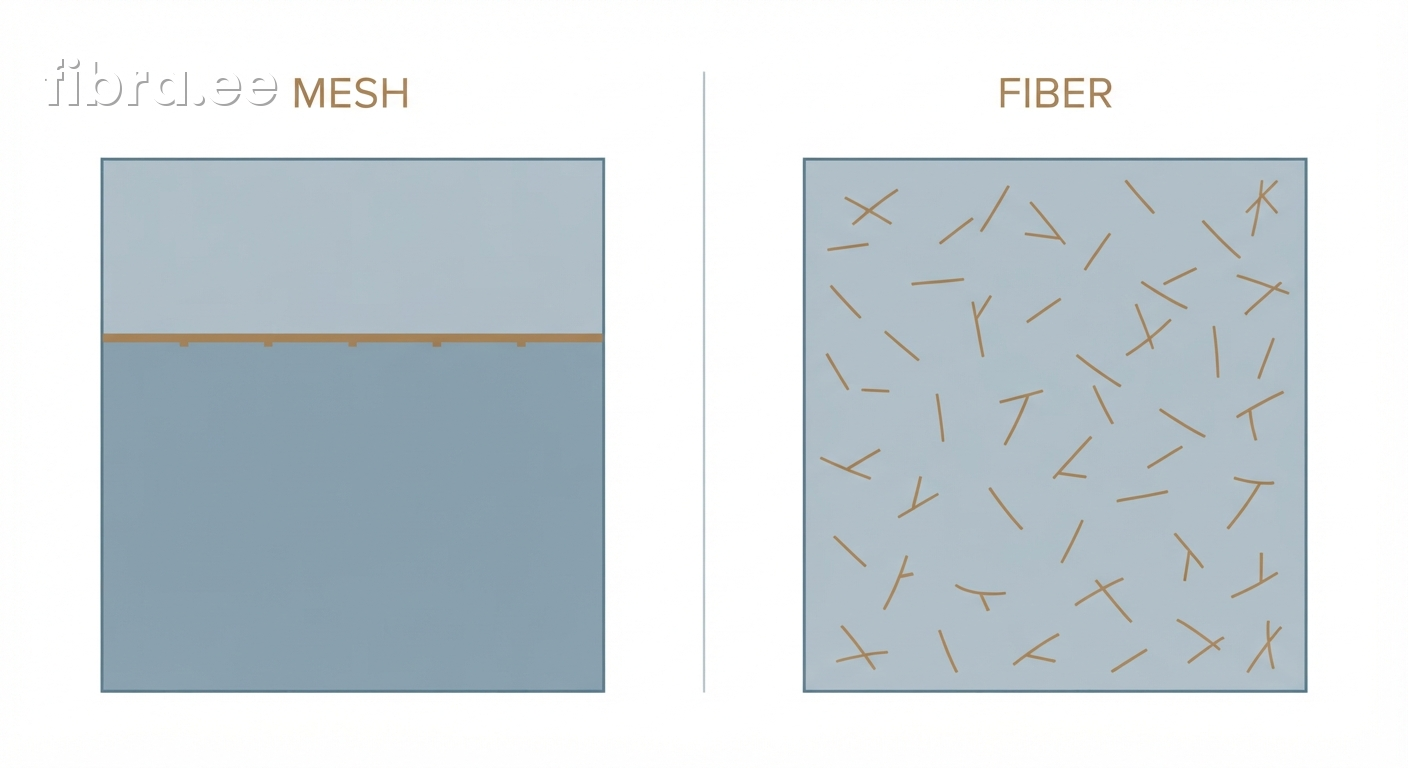
This mechanism has a practical advantage mesh doesn't have: fiber physically can't end up badly placed. It's mixed into the batch and distributed evenly throughout the volume regardless of how carefully the crew worked.
When fiber genuinely replaces mesh
Per the ACI 302.1R, ACI 330.2R and ACI 360R design guides (directly referenced by FIP-9), macrofiber is recognized as an acceptable substitute for secondary (temperature-shrinkage) reinforcement in slabs-on-ground, industrial and commercial floors, and parking structures. That's exactly the case for residential and commercial floor screeds without significant point loads: living spaces, floors under a finish covering, screeds over underfloor heating.
For underfloor heating specifically, fiber is established practice: according to The Screed Scientist, polypropylene fiber is used "in bonded, unbonded, floating screed constructions and in screeds installed over underfloor heating pipes" — precisely the screed types most commonly poured in apartments and houses.
When mesh is mandatory and fiber doesn't replace it
Fiber doesn't replace structural reinforcement where the screed (or slab) is designed as a load-bearing element carrying load along a defined structural path — beams, cantilevers, elements sized for load-bearing capacity. That's the same principle stated on this site's basalt fiber product page: fiber isn't a substitute for engineered load-bearing rebar. For floor screed this means: if the design involves point loads from heavy equipment, significant dynamic loads, or mesh is specified in the design as a load-bearing element (not shrinkage reinforcement) — that decision belongs to the structural engineer, and mesh can't be swapped for fiber on your own judgment.
Practical takeaway
For most residential and commercial screeds without special loading, fiber is the more reliable choice for shrinkage-crack control, precisely because it removes the human factor of laying mesh correctly. For structures where reinforcement serves a load-bearing function by design, fiber isn't the answer — mesh or rebar is required, and that choice stays with the structural engineer. In practice the two are often combined: mesh carries the structural role, fiber controls microcracking throughout the volume — they aren't mutually exclusive solutions.
For 12mm polypropylene microfiber (PPMIF12), used specifically for floor screeds and foundation work, the recommended dosage is 1.2–1.5 kg/m³. You can calculate the exact amount for your screed volume in the fiber calculator.
FAQ
Can mesh simply be replaced with fiber in any screed? No. Fiber replaces secondary (shrinkage) reinforcement — in cases where mesh also doesn't carry load by design. Where mesh is specified as a load-bearing element, the decision stays with the structural engineer.
Is mesh needed if the screed is poured over underfloor heating? For a typical residential screed over underfloor heating without point loads, fiber is established practice according to industry sources. Mesh here usually serves the same shrinkage-control role as fiber, just less reliably, due to the risk of incorrect placement.
What fiber dosage is needed for a floor screed? For PPMIF12 — 1.2–1.5 kg/m³, depending on conditions. Exact calculation — in the calculator.
To choose the right fiber type for your job (not just screed) — see PP, PVA, or Basalt Fiber: How to Choose the Right Type.