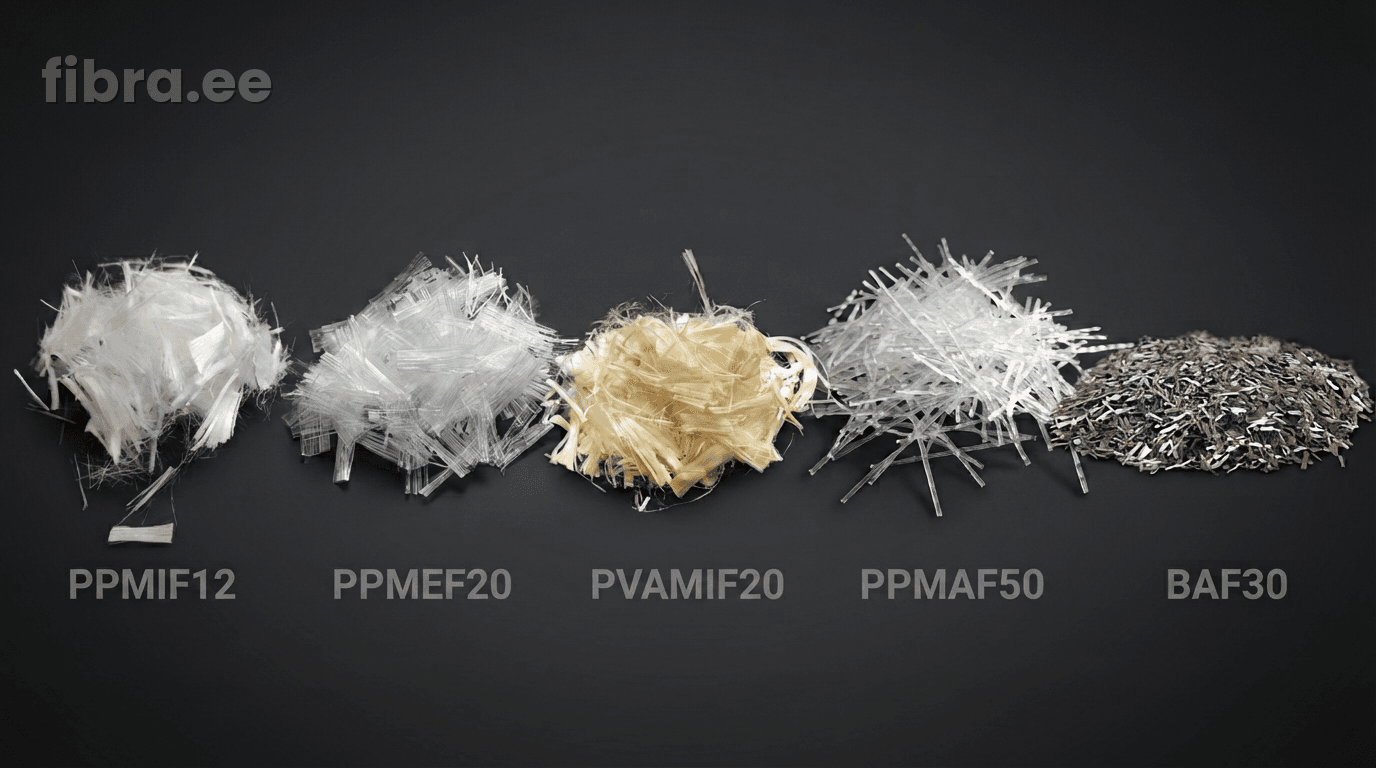
PP, PVA, or Basalt Fiber: How to Choose the Right Type
Polypropylene, PVA, and basalt fiber are all sold as concrete reinforcement, and the choice is almost always framed around price per kilogram. That's the wrong starting point. Each fiber type solves a different mechanical problem: one works in the first hours after pouring, another only matters once the concrete has hardened and is under load, a third is chosen mainly for corrosion resistance rather than strength. Cheap fiber bought for the wrong job doesn't save money — it just doesn't work.
Start with the job, not the material
Before comparing fiber types, define which specific problem you're solving:
- plastic shrinkage in the first hours after pouring — thin screeds, plaster, slabs cast outdoors;
- waterproofing layers or shotcrete, where fiber structure matters as much as dosage;
- crack-width control in hardened concrete under service load — industrial floors;
- residual strength after cracking in structural elements — historically the job of steel fiber alone;
- durability in wet or marine environments, where ordinary steel fiber corrodes over time.
Each of these problems has a physically optimal fiber type — the breakdown below goes from the lightest job to the heaviest.
Polypropylene microfiber — controlling plastic shrinkage
Polypropylene (PP) microfiber is the most common and affordable type. It works in the first 1–6 hours after pouring, while the concrete hasn't yet gained strength and is most vulnerable to plastic shrinkage. For the full mechanism, see Shrinkage Cracks in Concrete: Causes and How Fiber Prevents Them.
For plaster mixes and thin coatings, PP microfiber 6 mm at roughly 0.9 kg/m³ is usually enough. For floor screeds and thicker monolithic pours, PP microfiber 12 mm is used at 1.2–1.5 kg/m³ — the fiber calculator gives an exact figure for a specific volume.
PP mesh fiber — waterproofing and shotcrete
PP mesh fiber isn't the same fiber in a thicker form — structurally it's a fibrillated network rather than a monofilament strand like microfiber: during mixing it opens up into a mesh-like structure throughout the concrete. That produces two practical effects a monofilament fiber doesn't: better bonding in waterproofing screeds and a noticeable reduction in rebound during shotcreting (sprayed concrete).
Dosage is 0.9–2.0 kg/m³ depending on the job; for waterproofing screeds, 1.2 kg/m³ is the practical target.
PVA fiber — where polypropylene isn't enough
PVA fiber solves a different problem than polypropylene, and the difference isn't price — it's the fiber's surface chemistry. Polypropylene is hydrophobic: it doesn't bond well with cement paste, and its role in concrete is mostly to mechanically restrain a microcrack rather than adhere to it. PVA fiber, by contrast, is hydrophilic — it wets well and forms a strong adhesive bond with the cement matrix.
Practically, this means polypropylene fiber mostly does its work in the early, plastic stage, while PVA fiber is more effective in already-hardened concrete under service load — it keeps a crack narrower through adhesion, not just mechanical restraint. That's why PVA is the standard choice for heavily-trafficked industrial floors, at a dosage of roughly 1.5 kg/m³.
PP macrofiber — structural reinforcement and a steel fiber replacement
PP macrofiber 50 mm is a separate class, not a scaled-up microfiber. The fiber diameter is around 1 mm (versus hundredths of a millimeter for microfiber), and its purpose is different: not shrinkage control but residual strength after a crack has formed — what's known as post-crack toughness, standardly tested per ASTM C1609 (a flexural beam test that measures residual strength in fiber-reinforced concrete).
Per the supplier's certificate of analysis, tensile strength is at least 450 MPa and elastic modulus is around 5 GPa. This has historically been steel fiber's niche, and in many applications PP macrofiber genuinely replaces steel — it doesn't corrode and is noticeably easier to work with. Dosage depends on the required residual strength: from 4 kg/m³ for lighter jobs up to 8–10 kg/m³ for heavier structural elements — the calculator gives exact figures across three tiers.
Basalt fiber — premium reinforcement for wet and marine environments
Basalt fiber isn't a "stronger" version of polypropylene — it's a different mechanical class altogether. Per the certificate of analysis: tensile strength from 2600 MPa, elastic modulus 85 GPa — nearly 17× higher than PP macrofiber. This matters because elastic modulus determines how early a fiber starts carrying load. PP's modulus is far below concrete's own, so the fiber only really engages after a crack has already formed and the surrounding concrete has deformed. Basalt's modulus is much closer to steel's — the fiber restrains crack growth before damage becomes visible, rather than just "stitching" the concrete together after the fact.
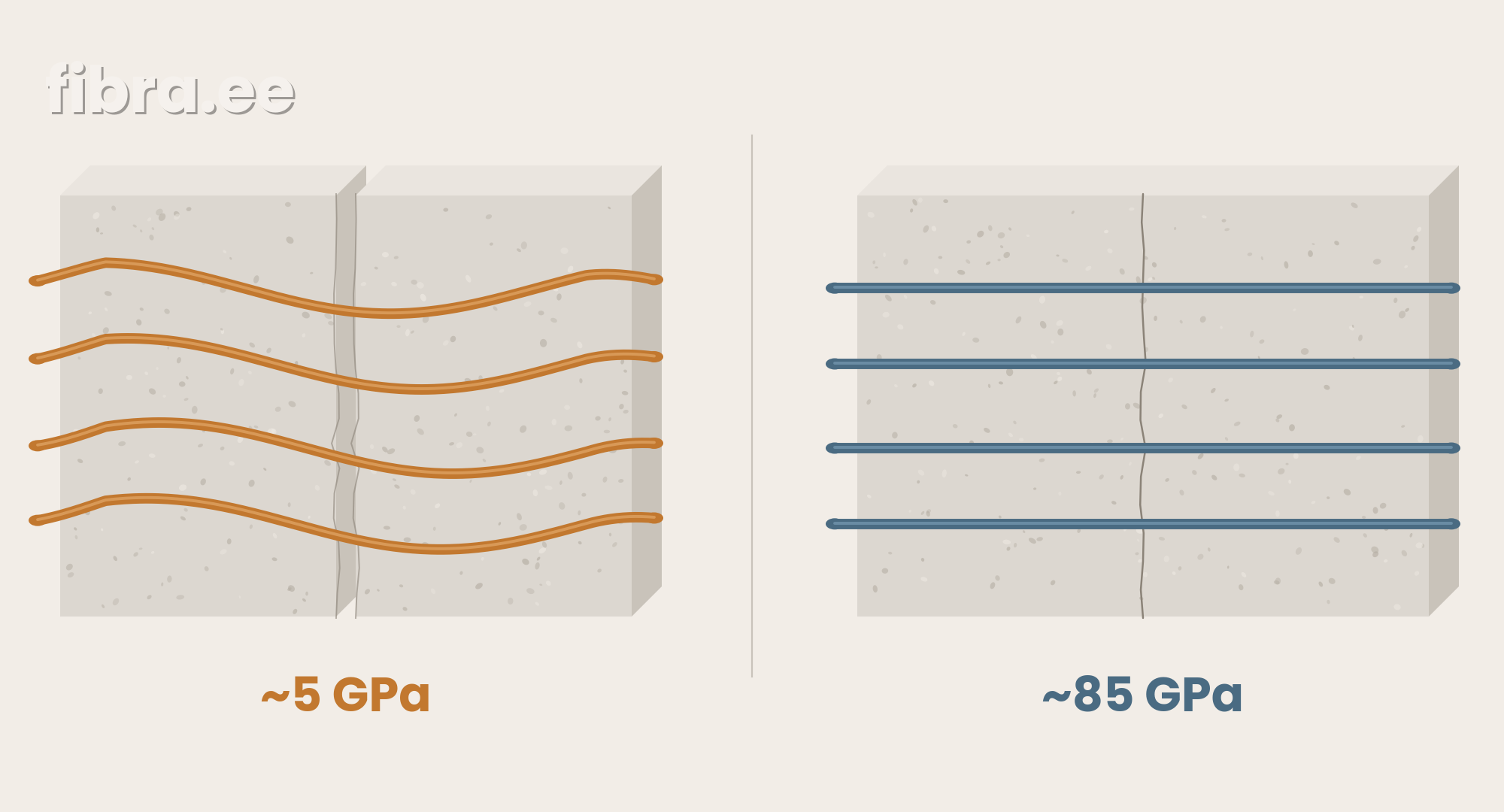
The second distinction is corrosion. Basalt is a mineral fiber, not a metal, so it doesn't rust. That's its real niche: applications that need mechanics close to steel (stiffness, crack control under load) but in a wet or marine environment — exactly where steel fiber eventually corrodes, leaving rust stains and spalled cover.
One important caveat: per the certificate of analysis, basalt's alkali resistance (strength retention in concrete's alkaline environment) is at least 80% — meaning the fiber isn't fully inert to alkali, but it retains the large majority of its strength, which is fundamentally better than ordinary glass fiber, which fails almost completely in concrete. And critically: basalt fiber is dispersed reinforcement, not a substitute for designed load-bearing rebar. For structural elements with a calculated bending moment (floor slabs, beams), a designed rebar cage remains mandatory — fiber works as a supplement to crack control, not a replacement for it.
Dosage is 3 kg/m³ — lower than PP macrofiber, precisely because each fiber does more mechanical work.
Summary table: job → fiber type → dosage
| Job | Fiber type | Dosage |
|---|---|---|
| Plaster, thin coating | PP microfiber 6 mm | ~0.9 kg/m³ |
| Floor screed, monolithic pour | PP microfiber 12 mm | 1.2–1.5 kg/m³ |
| Waterproofing, shotcrete | PP mesh fiber 20 mm | 0.9–2.0 kg/m³ |
| Industrial floor | PVA fiber 20 mm | ~1.5 kg/m³ |
| Structural reinforcement, steel replacement | PP macrofiber 50 mm | 4–10 kg/m³ |
| Wet, marine environment | Basalt fiber | ~3 kg/m³ |
For an exact figure for a specific pour, use the fiber calculator.
Frequently asked questions
Can PP and PVA fiber be mixed in the same batch? Technically yes, but it's usually not worthwhile: they address different stages — PP works in the early, plastic stage, PVA is effective once the concrete has hardened and is under load. It makes more sense to pick the type that matches the actual job than to combine both as insurance.
Why is basalt fiber better than steel? It doesn't corrode — basalt is a mineral fiber, not a metal, so it suits wet and marine environments where steel fiber eventually corrodes. Steel, on the other hand, has a longer track record and more standardization behind it; EN 14889-2 doesn't cover basalt.
Do I still need steel rebar if the concrete already contains fiber? Yes, if the element is structural and designed for a bending moment — floor slabs, beams. Fiber of any type is dispersed reinforcement for crack control and residual strength, not a substitute for a designed rebar cage.
Bottom line
The right fiber type is determined by the job, not price per kilogram: PP microfiber for plastic-shrinkage control, PP mesh fiber for waterproofing and shotcrete, PVA for industrial floors under load, PP macrofiber for structural reinforcement in place of steel, basalt for the same structural role in wet and marine environments. The calculator gives the exact dosage for a specific volume, the full range is on the products page, and other practical questions are answered in the FAQ.