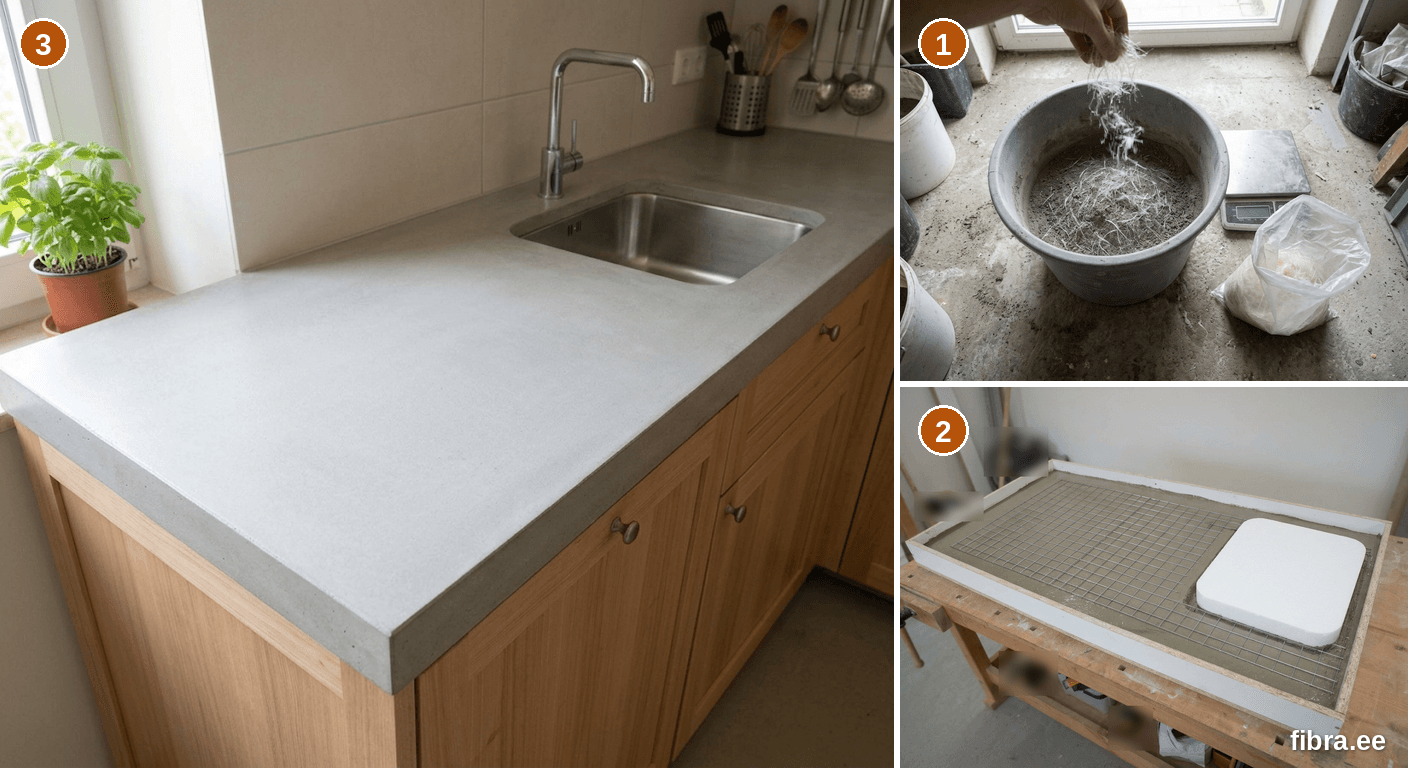
A concrete kitchen countertop or an outdoor kitchen table is a popular DIY project. Two things spoil the result most often: a network of fine cracks on the surface and chipped edges. You can avoid both by reinforcing the slab correctly and not rushing the curing. This article explains why a countertop needs both mesh and fiber, how much fiber to add and how to cast the countertop step by step.
Mesh and fiber in a concrete countertop
A countertop needs reinforcing mesh. Fiber does not replace the mesh, it complements it.
| Role | Steel mesh | PVA fiber |
|---|---|---|
| What it does | Carries the load and stops the slab from breaking when moved, installed and loaded | Controls shrinkage cracks on the surface and protects the edges from chipping |
| Where it works | In one plane inside the slab | Throughout the mix, including the visible face and the edges |
| Needed? | Required | Recommended |
The mesh sits inside the slab and does not stop hairline cracks from forming on the surface. Fiber spreads through the whole mix, including near the visible face and the corners, where cracks and chips show most. Read more about the causes of cracking in Shrinkage cracks in concrete.
How much fiber for a concrete countertop
For countertops we recommend PVA microfiber 20 mm: 1.5 kg per 1 m³, which is about 19 g per 25 kg bag of dry mix.
Example: a countertop 120 × 60 cm, 5 cm thick.
| Item | Value |
|---|---|
| Volume | 120 × 60 × 5 cm = 36 l |
| Dry mix | ≈ 72 kg, i.e. 3 bags of 25 kg |
| PVA fiber | ≈ 57 g |
| Fiber cost | ≈ €2 for the whole countertop |
| Weight of the finished slab | ≈ 80 kg |
The calculator works out the amounts for your own dimensions.
Thickness, mix and mold
- Thickness: kitchen countertop 40–50 mm, outdoor table 50–60 mm.
- Mix: fine concrete with aggregate up to 8 mm and a strength class of at least C25/30. Coarse gravel does not suit a thin slab.
- Mold: film-faced plywood or melamine board, with the joints sealed with silicone. Cast the visible face upside down against the bottom of the mold so it comes out smooth.
- Sink cutout: a piece of foam fixed to the bottom of the mold. Round its corners: cracks start from sharp corners of a cutout.
How to cast a concrete countertop
- Prepare the mesh. Galvanized welded mesh, cut so that it stays 2–3 cm from the sides of the mold. Add rebar around the sink cutout.
- Mix dry first. Sprinkle the fiber into the dry mix a little at a time and mix until the fibers are spread out with no clumps. Then add water as the bag says, and no more: excess water is the main cause of shrinkage cracks.
- Pour the main layer. Fill the mold to about 2/3 of its depth and tap the mold so air bubbles rise to the surface.
- Place the mesh. The mold is cast upside down, so the open top of the mold becomes the underside of the finished countertop. The underside is the side in tension, so the mesh must be close to it: 15–20 mm below the rim of the mold.
- Pour the rest up to the rim, tap again and level with a straightedge.
- Curing. Cover with plastic and keep the slab moist for about a week. Slow drying is the key to a crack-free slab.
- Demolding and installation. Remove the mold after 5–7 days. Turn and move the slab with two people. Install the countertop no earlier than two weeks after casting.
If the countertop overhangs its support by more than 20–30 cm, the overhang is in tension on its top side and mesh alone is not enough: it needs reinforcement designed for the load.
Wear safety glasses and a dust mask when opening the fiber pack and measuring the fiber.
How to protect a concrete countertop
Concrete is porous, so the countertop needs sealing: with oil (for example linseed oil) or a food-safe concrete sealer. Repeat the treatment regularly. Put hot pans on a trivet so the sealer is not damaged.
FAQ
Can a countertop be made with fiber only, without mesh? No. Fiber reduces surface cracks and chipping, but it does not carry the load. A countertop needs mesh, and large overhangs need rebar.
How thick should a concrete countertop be? 40–50 mm in a kitchen and 50–60 mm for an outdoor table. We do not recommend a countertop thinner than 40 mm in ordinary concrete.
Will the fiber show on the surface? On a face cast against a smooth mold bottom the fiber usually does not show. Deep grinding can expose individual fibers, which are cut or sanded off.
Can PP fiber be used instead of PVA? PP microfiber 12 mm also reduces shrinkage cracks and costs less. PVA bonds better with the cement and also controls cracking in hardened concrete, so for countertops we recommend PVA.
Summary
- A countertop needs mesh, and PVA fiber complements it.
- About 19 g of PVA fiber per 25 kg bag: about €2 for a 120 × 60 cm countertop.
- Thickness 40–50 mm in a kitchen, 50–60 mm outdoors.
- Mix the fiber into the dry mix before the water. When casting upside down, place the mesh close to the open top of the mold.
- For smaller pieces, see DIY concrete planters without cracks; the fiber cost per bag is in DIY fiber concrete.