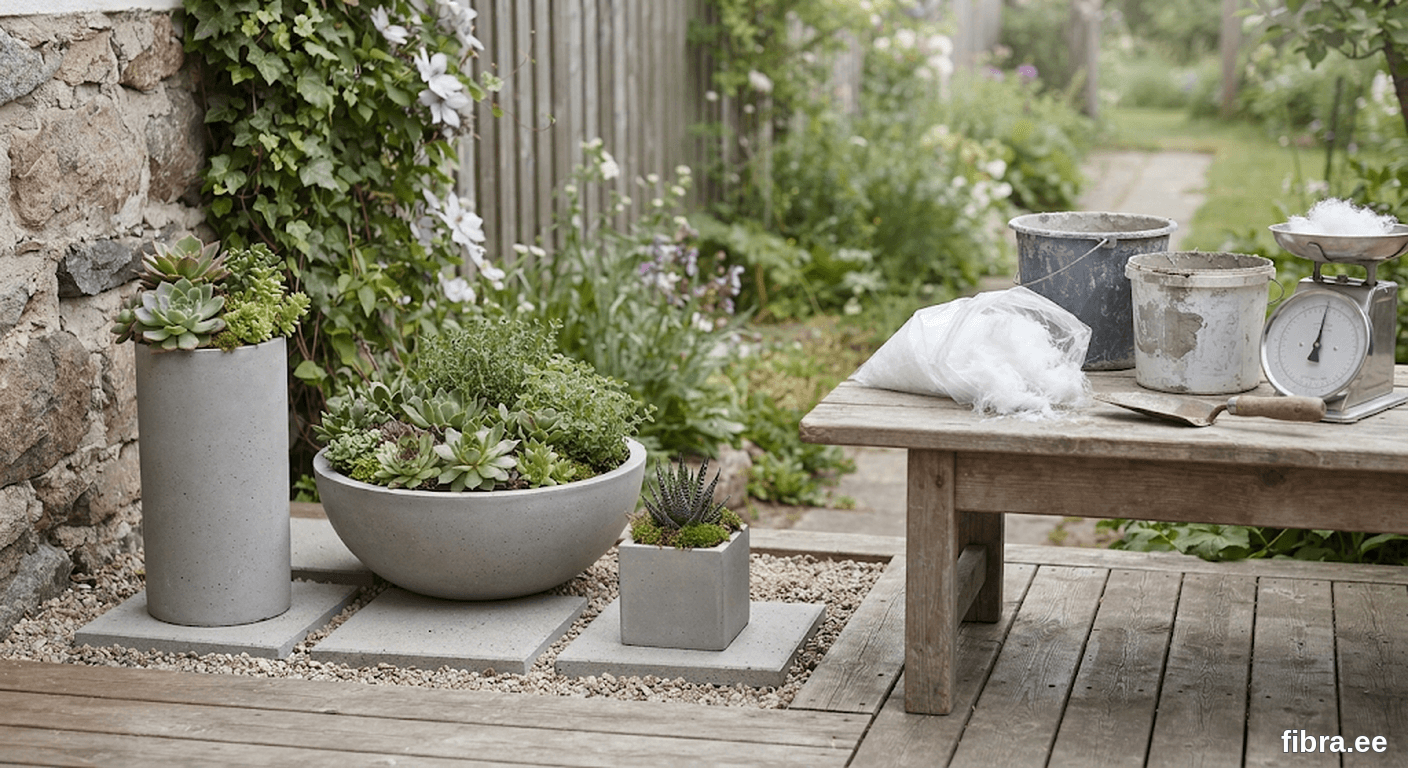
Concrete planters, garden pavers, candle holders and small tables are popular DIY projects. The most common problem is always the same: thin concrete cracks while drying or chips at the edges when you take the piece out of the mold. Polypropylene fiber helps with exactly that. This article shows how much fiber to add to a small batch, which fiber suits which project and how to mix it in.
Why add fiber to concrete crafts
- Fewer cracks. Fiber takes up the shrinkage stresses in the first hours, when thin walls and edges crack most easily.
- Stronger edges. Fiber holds the mix together, so corners and edges chip less when you demold.
- No mesh needed. It is hard to fit mesh into a wall a couple of centimetres thick. Fiber spreads through the whole mix by itself.
Read more about the causes of shrinkage cracks in Shrinkage cracks in concrete.
How much fiber for a small batch
The dosage of polypropylene fiber is about 0.9 kg per 1 m³ of concrete. 2 kg of dry mix makes about 1 litre of finished mix, so for crafts a simple rule is enough: about 1 g of fiber per litre of mix.
| Amount of mix | Dry mix | PP microfiber 6 / 12 mm | PVA microfiber 20 mm |
|---|---|---|---|
| 1 l | ≈ 2 kg | ≈ 1 g | ≈ 1.5 g |
| 2.5 l | 5 kg | ≈ 2 g | ≈ 4 g |
| 5 l | ≈ 10 kg | ≈ 4.5 g | ≈ 7.5 g |
| 10 l (a bucket) | ≈ 20 kg | ≈ 9 g | ≈ 15 g |
| 12.5 l (25 kg bag) | 25 kg | ≈ 11 g | ≈ 19 g |
Small amounts are easiest to weigh on a kitchen scale. To find the volume of a mold, measure how much water it holds. One 150 g pack of PP fiber is enough for about 165 litres of mix — dozens of planters and pavers.
For reference: 11 g of PP fiber per 25 kg bag is a small handful. You can see a photo of the right amount on the product page.
Which fiber to choose
| Project | Fiber | Why |
|---|---|---|
| Thin pieces: candle holders, small planters, decor, walls under 3 cm | PP microfiber 6 mm | The short fiber mixes evenly into a thin mix and shows least on the surface. |
| Larger planters, garden pavers, stepping stones, walls 3–6 cm | PP microfiber 12 mm | The longer fiber controls cracking in a thicker casting. |
| Table tops, benches, window sills | PVA microfiber 20 mm | PVA fiber bonds with the cement and also improves the crack resistance of hardened concrete. |
Fiber does not replace reinforcement in load-bearing structures. If a table top or bench is long and will carry a load, add steel mesh or rebar as well as fiber.
How to reinforce a countertop with mesh and fiber: DIY concrete countertops without cracks.
How to mix fiber into a small batch
- Weigh the dry mix and the fiber.
- Sprinkle the fiber into the dry mix a little at a time and mix dry until there are no clumps of fiber.
- Add water as the bag instructions say and mix until smooth.
- Pour into the mold and tap the mold so air bubbles rise to the surface.
When using a concrete mixer, add 2/3 of the water first, then the fiber, then the dry mix and finally the rest of the water.
Wear safety glasses and a dust mask when opening the pack and measuring the fiber.
How to make a concrete planter
- Mold: two buckets or plastic containers — an outer one and an inner one that is 2–3 cm smaller on every side.
- Oil the inside of the outer mold and the outside of the inner mold with cooking oil so the planter releases easily.
- Make a drainage hole: press a piece of pipe or a cork into the bottom of the outer mold.
- Mix: dry mix and fiber as in the table, then water. The mix should be thick, not runny.
- Pour: pour 2–3 cm of mix into the bottom, set the inner mold in place and weigh it down, for example with sand or stones. Fill the gap and tap the mold.
- Curing: cover with plastic and remove the molds after 1–2 days. Let the planter cure for about another week and rinse it well before planting.
Tips for a clean finish
- Loose fibers on the surface. A few fibers may show on the surface against the mold. Once the concrete has hardened, remove them by light sanding or cutting.
- Slow drying. Cover the piece with plastic for the first day. Slow drying reduces cracking even more.
- Hypertufa. In a hypertufa planter (cement with peat), use fiber at the same dosage: about 1 g per litre of mix.
FAQ
Does a small planter need fiber? Not necessarily, but it clearly reduces edge chipping and drying cracks, especially in thin walls. The fiber for a typical planter costs less than 20 cents.
Can fiber be added to a ready-made dry mix? Yes. Mix the fiber into the dry mix before adding water: about 11 g per 25 kg bag and about 2 g per 5 kg.
Will the fiber show on the finished piece? Inside the mix the fiber is not visible. A few fibers may show on the surface and can be sanded off. 6 mm fiber shows least.
Summary
- For crafts, about 1 g of PP fiber per litre of mix is enough.
- Thin pieces: PP 6 mm; larger planters and pavers: 12 mm; table tops and benches: PVA.
- Mix the fiber into the dry mix before the water.
- One 150 g pack is enough for about 165 litres of mix.
- The calculator works out amounts for larger pours, and the cost per bag is in DIY fiber concrete.